
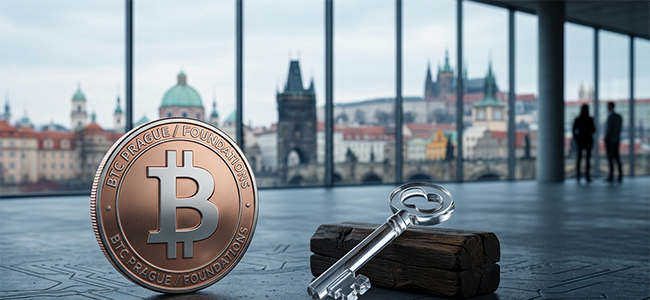
Every year, Bitcoin enthusiasts from around the world gather to exchange ideas, explore technological advances and discuss the future of decentralised money. This year’s BTC Prague conference once again demonstrated that Bitcoin has matured from a niche technological experiment into a global movement centred on financial freedom, individual responsibility and long-term wealth preservation.
What made the conference particularly noteworthy was that it took place during a period of relative weakness in Bitcoin’s price. Yet there was remarkably little discussion about market volatility. Instead, the emphasis was on education, technology, security and the practical realities of living in an increasingly digital financial world.
The atmosphere reflected a community that has moved beyond speculation and is now focused on building durable systems capable of serving individuals and businesses for decades to come.
Bitcoin Is More Than an Investment
For many people, Bitcoin begins as an investment.
However, one quickly discovers that it represents something much broader. Bitcoin allows individuals to own and transfer wealth without depending entirely upon banks or other financial intermediaries. In doing so, it fundamentally changes the relationship between the individual and money.
With this freedom comes responsibility.
Unlike traditional banking systems, there is no customer service department capable of reversing incorrect transactions or restoring forgotten passwords. Ownership requires discipline, planning and a clear understanding of personal responsibility.
Throughout the conference, speakers repeatedly emphasised that freedom and responsibility cannot be separated. The greater the financial independence one enjoys, the greater the obligation to manage one’s affairs carefully.
The Importance of Self-Custody
Few subjects attracted more attention than self-custody.
The principle is straightforward: if Bitcoin is held by someone else, ultimate control remains with that third party. Genuine ownership is achieved only when individuals control their own private keys.
Achieving this safely requires careful planning.
Delegates explored hardware wallets, secure backup procedures, multi-signature solutions and disaster recovery planning. Equal emphasis was placed on avoiding human error, which remains one of the greatest risks associated with digital assets.
The message was refreshingly practical. Technology provides the tools, but sound procedures and disciplined behaviour provide the real security.
Privacy and Financial Sovereignty
Financial privacy emerged as another recurring theme.
Modern payment systems generate enormous amounts of personal financial data. While regulatory oversight remains essential for combating financial crime and maintaining confidence in financial markets, many participants expressed concern about the gradual erosion of individual privacy.
Bitcoin offers individuals greater control over their own financial information, although responsible speakers consistently distinguished legitimate privacy from secrecy or unlawful conduct.
Privacy was instead presented as a fundamental component of personal liberty, comparable to legal professional privilege or medical confidentiality.
The discussion reminded attendees that technological progress should strengthen individual rights rather than diminish them.
Education Is the Greatest Investment
Perhaps the strongest consensus throughout the conference was that education remains the most valuable investment anyone can make.
Many costly mistakes occur not because Bitcoin is inherently complicated, but because users underestimate the importance of understanding the technology.
Sessions covered cyber security, estate planning, operational security, taxation, inheritance structures and long-term investment discipline.
Experienced Bitcoin holders consistently shared one characteristic: they never stop learning.
Rather than reacting emotionally to short-term price movements, they focus on continuous education, careful planning and disciplined decision-making.
These principles apply equally to investing, business and professional practice.
Planning for Future Generations
One of the fastest-growing areas of discussion concerned succession planning.
Unlike traditional assets held by banks or investment institutions, Bitcoin depends upon access to cryptographic keys. Without proper planning, digital wealth can become permanently inaccessible following death or incapacity.
This reality has significant implications for estate planning.
Families must ensure that trusted beneficiaries understand not only the existence of digital assets but also the practical procedures required to gain lawful access when the time comes.
Increasingly, attorneys, trustees and financial advisers are being called upon to develop expertise in this emerging field.
Innovation Continues Regardless of Market Cycles
One of the conference’s most encouraging observations was the pace of innovation.
Developers unveiled improvements in hardware wallets, payment systems, privacy technologies, educational platforms and digital security.
Unlike many industries where development slows during weaker economic conditions, Bitcoin innovation appears remarkably resilient.
The network continues to evolve irrespective of market cycles.
This long-term approach reinforces confidence that Bitcoin’s future depends less upon temporary price movements and more upon the continuous improvement of its underlying infrastructure.
A Truly Global Community
Visitors to BTC Prague encountered attendees representing every continent, profession and age group.
Despite their diverse backgrounds, participants shared several common values: individual responsibility, private property, voluntary exchange, technological innovation and long-term thinking.
The conference therefore represented much more than a gathering of investors.
It demonstrated the emergence of an international community committed to building a more open and resilient financial system.
Bitcoin has become a genuinely global phenomenon, transcending political systems, national borders and cultural differences.
Lessons Beyond Bitcoin
Even readers with little interest in cryptocurrency may find several broader lessons emerging from Prague.
First, technological innovation increasingly requires individuals to assume greater personal responsibility rather than relying solely upon institutions.
Secondly, financial literacy has become an essential life skill.
Thirdly, cyber security is no longer optional. As more personal and financial information moves into digital form, protecting digital assets becomes an indispensable responsibility.
Finally, long-term thinking consistently outperforms short-term speculation.
Whether investing, managing a business or planning an estate, patience, discipline and sound judgement remain among the most valuable qualities an individual can possess.
The Professional’s Perspective
For legal practitioners and professional advisers, the themes emerging from BTC Prague carry important practical implications.
Digital assets are no longer a niche investment. They are becoming an increasingly significant component of personal and corporate wealth. Clients are beginning to expect informed advice not only on acquiring Bitcoin, but also on secure custody, taxation, succession planning, regulatory compliance and estate administration.
The legal profession has a particularly important role to play in this evolving landscape. Trust structures, wills, shareholder agreements, lending arrangements, insolvencies and deceased estates increasingly require an understanding of digital assets and the unique legal challenges they present.
Professionals who develop expertise in these areas will be well placed to assist clients in protecting and transferring wealth in an increasingly digital economy.
Conclusion
Perhaps the greatest lesson from BTC Prague is that technology alone does not create financial freedom.
Freedom is achieved through knowledge, careful planning and responsible decision-making.
Bitcoin may be one of the most important financial innovations of the modern era, but its greatest contribution may ultimately be encouraging individuals to think differently about ownership, responsibility and the long-term preservation of wealth.
For attorneys, accountants, trustees, business rescue practitioners and financial advisers, understanding these developments is becoming more than an intellectual exercise. It is rapidly evolving into a professional necessity.
Whether or not Bitcoin becomes a permanent part of every investment portfolio, the broader principles discussed in Prague—personal responsibility, financial sovereignty, digital security and long-term stewardship—are likely to shape the future of wealth management for many years to come.
A revised version of an article originally published by The Bitcoin Way